

Ω
JEANNE D’ARC AUTHENTICATED
Ω JEANNE D’ARC AUTHENTICATED

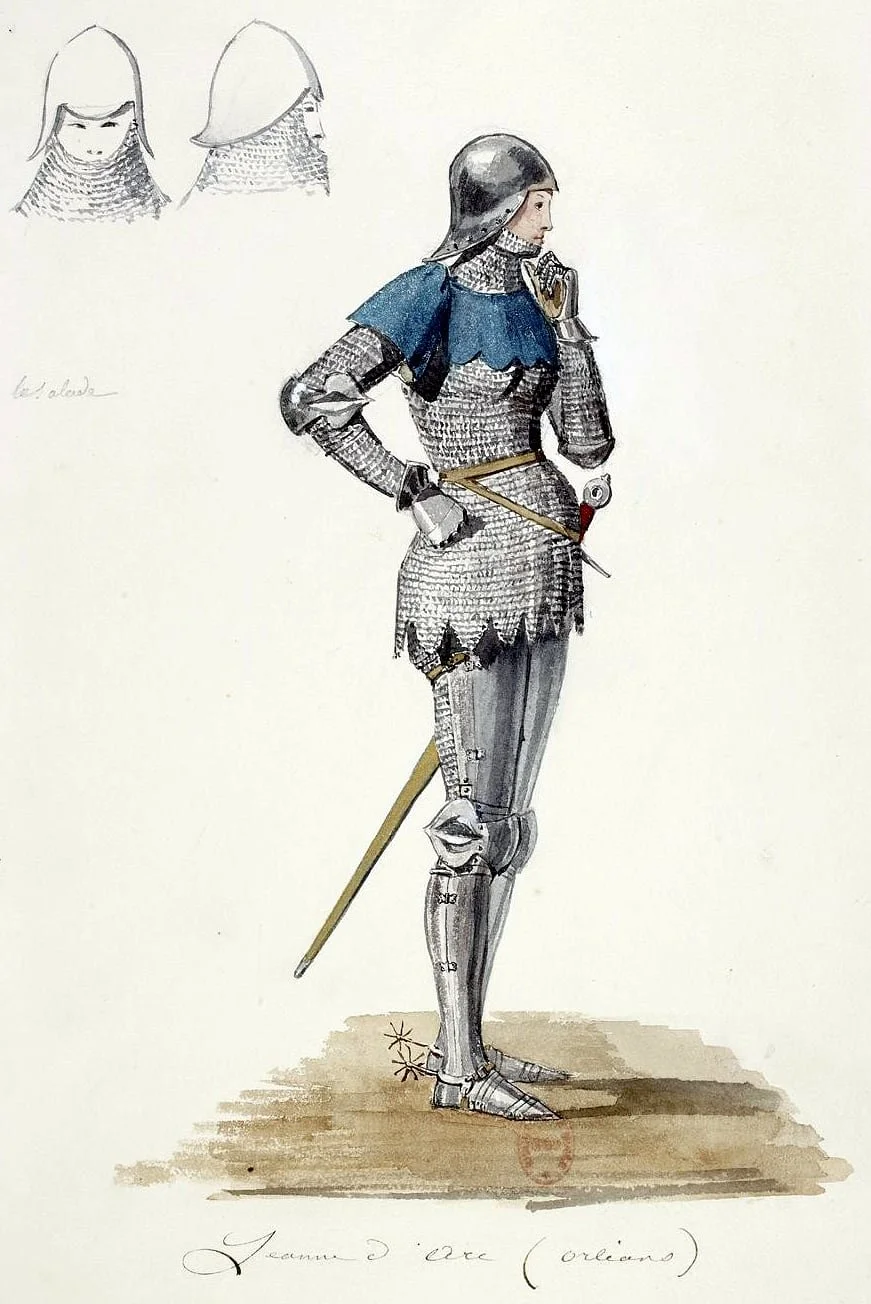

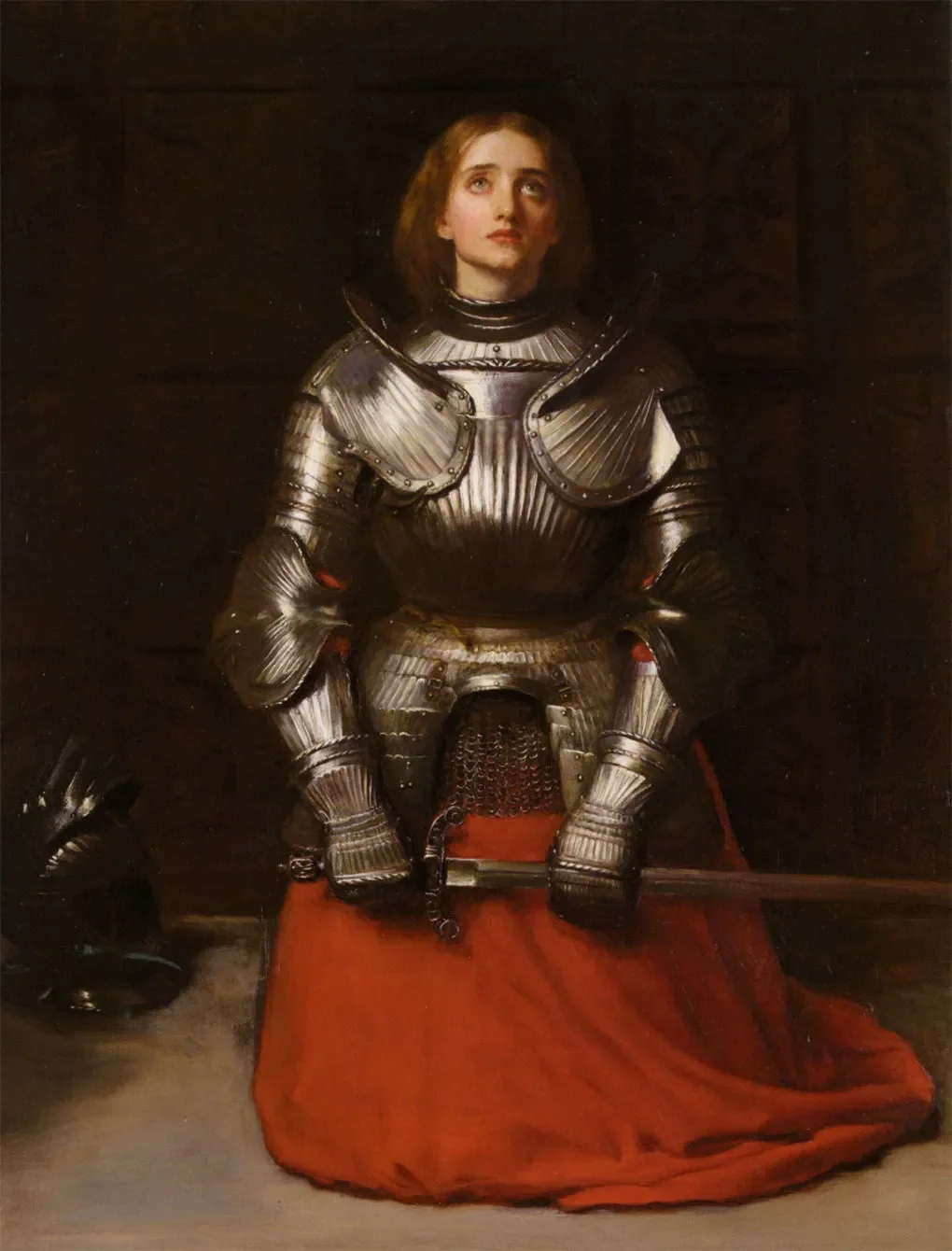
Official Product of LAROCHELLE
Saint Jeanne d’Arc — Joan of Arc — stands among history’s most luminous figures. A shepherd girl whose life moved with unusual clarity. From pastoral solitude to the thunder of war, and finally to the slow, deliberate cruelty of a politicized trial and public execution; the common thread of illumination throughout being her unwavering faith in Christ Jesus — the Light of the world. Her story reads like a paradox in motion: humility and ferocity; divine conviction and human betrayal; simplicity of origin and immense consequence for a nation.
A daughter of Domrémy, France, Jeanne’s early years were ordinary in the rural sense. She tended sheep, learned the rhythm of the seasons, and listened to the small certainties of village life. From that quiet beginning came a moral steadiness. The image of the young shepherd standing in a field, hearing what others could not hear, is not one of manic prophecy but of patient attentiveness — a spirit sharpened by prayer, work, and the ordinary virtues of a devout household.
Jeanne’s visions began in adolescence at the age of 13 years old. She was first visited by Michael the Archangel and his message was to persist in prayer, continue to practice disciple in virtue and that Saint Margaret and Saint Catherine would soon follow after him. The apparitions become more frequent and just as Saint Michael had foretold, two luminous women who radiated a divine glory and adorned with beautiful crowns appeared to her alongside the Archangel Michael. They introduced themselves as the very same Margaret and Catherine now crowned Saints of Jesus Christ and they shared in encouraging Jeanne in Christian virtue. They spent the next 3 years teaching her and guiding her, evidently to prepare her for her mission. At the appointed time, the purpose of her preparation was revealed.
By the time she was 16, providentially, she was ready to be sent forth. At just 18 years old, Jeanne persuaded French authorities that the LORD had instructed her to lead a military campaign that would enable the Dauphin Charles VII to be rightfully crowned king of France in Reims — which had been overtaken by the English. In her testimony, Jeanne confidently confesses that she witnessed these apparitions with her “bodily eyes” as well as simply hearing “her voices” accompanied by Church bells.
She was instructed to meet with the dauphin and offer her mission to further the rightful heir’s endeavors against the English. Far from assuming her claims uncritically, the ecclesiastical authorities in Charles’ court subjected her to rigorous examinations. Clergy tested her orthodoxy, questioned her motives, and deliberated whether she was deceived, deceptive, or genuinely led by God. These inquiries were painstaking and formal; they asked whether her visions aligned with Church teaching, whether she sought fame or profit, and whether she demonstrated the humility expected of a true seer. She passed all of these tests definitively — a very important historical note: learned men concluded she was not fabricating her experiences but rather, determined that her spiritual life was not merely the product of popular rumor, but the subject of a disciplined and unwavering zeal to serve God, and God alone. At least at that time, this determination was ruled as sound; the apparitions and messages from the Saints to Jeanne were credible and authoritative.
Armed with this conviction and the backing of local authorities convinced of her authenticity, Jeanne crossed into the arena of war — not as a strategist by training, but as a commander by divine conviction. Her leadership style was unusual: she did not pretend to know every technicality of warfare, but she galvanized troops with moral clarity, an unshakeable mission, and a visible symbol of divine purpose.
In 1429 she lead the outnumbered French forces in the siege of Orléans to victory! This set in motion providential events that shifted the momentum in favor of the French. These victories were not merely military successes; they were acts that reoriented national morale. With Jeanne at the fore, the idea that the Dauphin could be more than a claimant became credible. Reims, France was the traditional city for coronation for the French, so because of the English occupation, this endeavor seemed hopeless. With thanks to God, and His servant, Jeanne — a youthful shepherd girl — she accompanied Charles VII to Reims. There, they secured the coronation that solidified his claim to the throne. For many contemporaries, those campaigns were proof that divine providence, through an unlikely instrument, had intervened in human affairs.
Yet the same forces that benefited from her courage would ultimately betray her. Political power rarely tolerates an autonomous actor whose moral authority can eclipse—however briefly—the authority of kings and courts. In 1430 she was captured by Burgundian forces and sold to the English. The very country and king she had fought to place on the throne did not mount an effective rescue; the now “King” Charles decided against moral righteousness. Realpolitik and dynastic interest outweighed loyalty to the woman whose actions had made coronation possible.
Her trial was a carefully staged process, not an honest search for truth. Conducted under an ecclesiastical court that had formally shared loyalty to the English — now in liberated France — driven by political ends, the interrogations completely disregarded how she had once been deemed Providentially inspired while they alleged of her supposed military misdeeds. Judges sought to frame her visions and actions as heresy, dressing political immorality in doctrinal language. She was questioned about “her voices”, her wearing of male attire, and her submission to clerical authority. Contemporary accounts show that Jeanne answered with simplicity and fidelity to her inner experience: she maintained that she heard and followed God’s command and that her “cross-dressing” served practical ends in wartime and imprisonment. Under enormous pressure, and despite the manipulation of procedure, she typically demonstrated a composed intelligence and a moral clarity that disarmed many observers.
The trial’s verdict was, in many ways, preordained. The sentence of death by burning at the stake was solemnly announced, and on the morning of May 30, 1431, Jeanne faced her execution in Rouen with quiet dignity. She was 19 years old.
Even in the final hour, numerous witnesses recorded her remarkable composure. She is said to have called upon the name of Jesus Christ; she spoke plainly of mercy and forgiveness for those who condemned her, offering prayers rather than recrimination. In the face of such barbarity, she held fast to a Christian posture of pardon: an unshakable example of grace under fire.
Finally, the account recorded on the executioner’s receipt stands unmistakable: though her body was incinerated three times, reduced each time to ash and bone, one thing would not yield to flame. Her heart—alone—remained incorruptible. Witnesses described it as whole, warm, and untouched by the scorching heat that consumed everything around it. The document, penned in sober hand, treats the fact not as legend but as evidence: a single, surviving heart, carried from the pyre like a quiet testament to something beyond the fire’s reach.
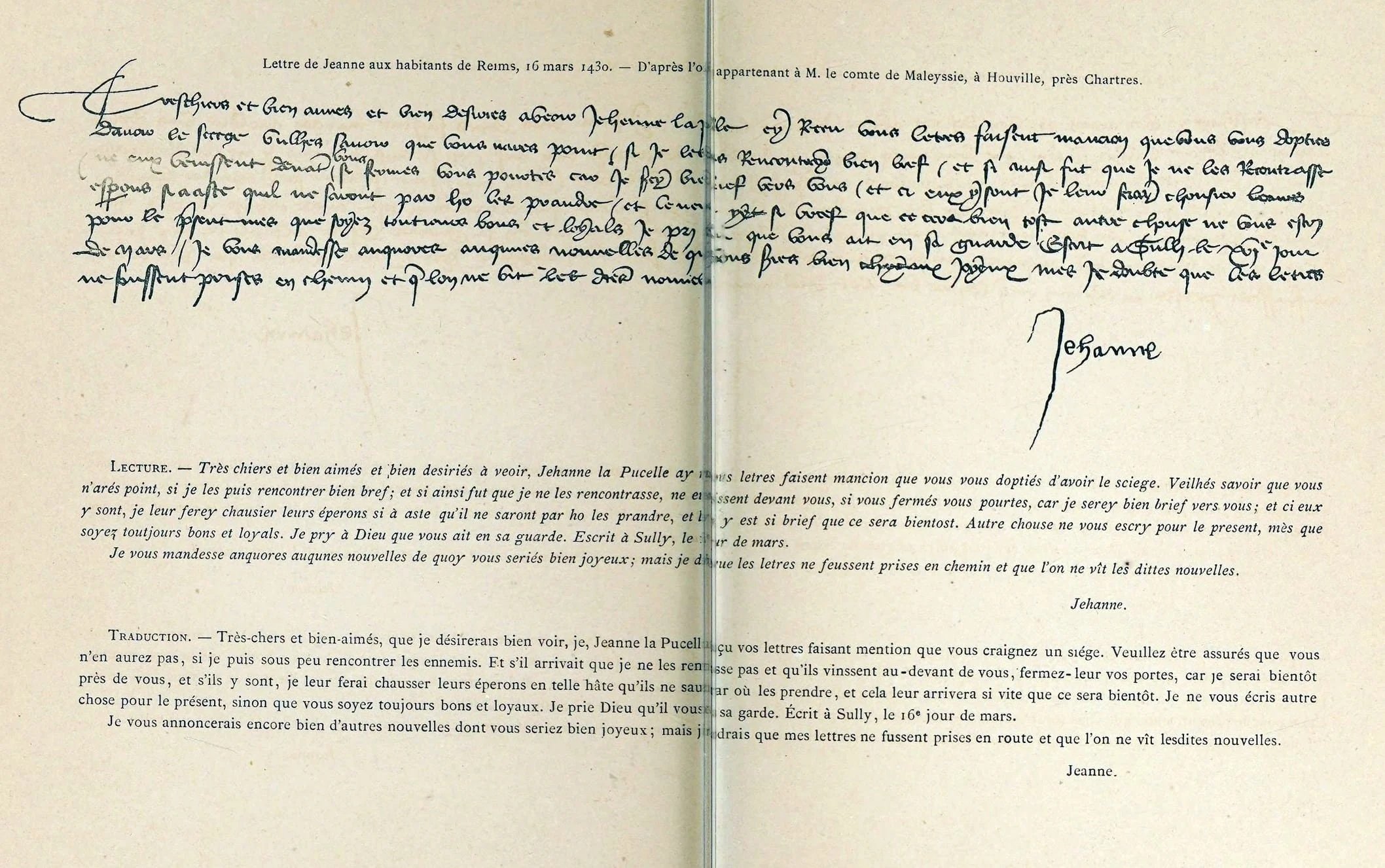
Translation of Jeanne’s letter to her loved ones in Reims:
“To my very dear and good friends, men of the Church, bourgeois, and other inhabitants of the town of Reims Very dear and well-beloved, whom I greatly desire to see: I Jeanne the Virgin have received your letters mentioning that you fear facing a siege.
Know then that you will not, if I can meet them soon. And if it should so happen that I do not intercept them and they come against you, then shut your gates, for I will be with you shortly. And if they are there I will make them put on their spurs in such haste that they won’t be able to do so; and their time will be short, for this will be soon. I won’t write you anything else for the present, except that you should always be obedient and loyal. I pray to God to hold you in His keeping.
Written at Sully the 16th day of March. I would send you some further news which would make you quite happy, but I fear that the letters would be captured on the road, and that the news would be seen.”
Jeanne